
• Skip to primary navigation
  • Skip to main content
  • Skip to primary sidebar
  • Home
  • Research
  • Publications
  • News
  • People
  • Opportunities
  • Links
  • Contact Us

Bioastronautics and Human Performance

Texas A&M University College of Engineering

Research

Physiology

Artificial Gravity as a Countermeasure for Human Spaceflight Deconditioning

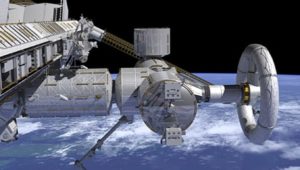
There have been proposals over the years for centrifuge modules on the ISS to study artificial gravity. Image credit: Mark Holderman/NASA.

Astronauts experience a strong physiological deconditioning during space missions, primarily due to the weightless conditions. Some of these adverse consequences include bone loss, muscle atrophy, sensory-motor/vestibular deconditioning, visual impairment, and overall cardiovascular adaptation, which may lead to orthostatic intolerance when astronauts are exposed again to a gravitational environment. Physiological deconditioning will be even more challenging in future long-duration space missions, for example to Mars, in which astronauts will be exposed to weightlessness for six to eight months before landing without external help to support egress. In order to mitigate these negative effects, several countermeasures are currently in place, particularly very intensive exercise protocols. However, despite these countermeasures, physiological deconditioning still persist to a certain degree, highlighting the need for new approaches to maintain the astronauts’ physiological state within acceptable limits.

Artificial gravity (generated by centrifugation) has long been suggested as a comprehensive countermeasure that is capable of challenging multiple physiological systems at the same time, therefore maintaining overall health during extended weightlessness. However, human centrifuges hasn’t been tested in space, and there are still many questions about its implementation (including centrifuge configuration, exposure time, gravity level, gravity gradient, and use/intensity of exercise, etc). We want to investigate these research questions using a combination of human experiments on ground-based centrifuges and modeling techniques of physiological systems to complement the experimental results.
Cardiovascular Physiology after Deconditioning

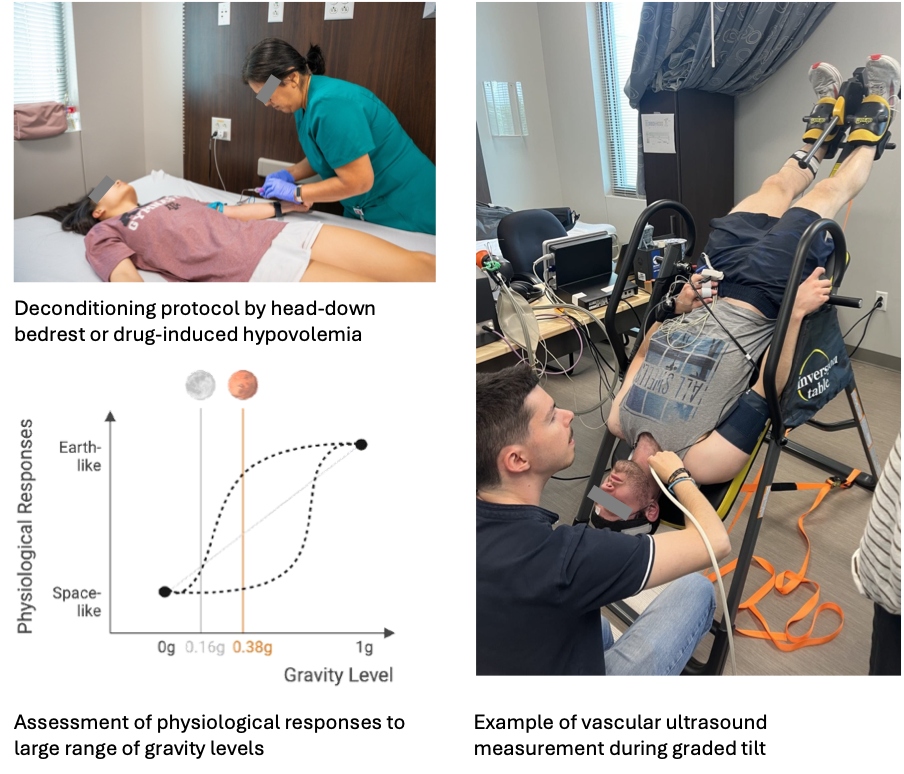
Led by Dr. Adrien Robin and Dr. Ana Diaz-Artiles and supported by a postdoctoral grand from the Translational Research Institute for Space Health (TRISH), this project examines how graded gravitational stress (from head-down to head-up tilt) shapes cardiovascular and ocular function in healthy adults. In a crossover design, participants (men and women) complete two deconditioning protocols: (1) 48 hours of head-down bed rest and (2) a drug-induced hypovolemia (using diuretic). During each session we systematically vary body angle and continuously measure hemodynamics, fluid transfert, and vascular/ocular indices. Our goal is to define sex-specific dose–response curves to gravity and identify mechanisms of deconditioning. Findings will inform astronaut health risk models and enable individualized countermeasures such as optimized exercise, fluid loading, and compression garments. The work also translates to Earth, supporting better management of syncope, safer perioperative positioning (e.g. Trendelenburg position), and more effective rehabilitation strategies for older or bedridden patients.

Closed-Loop Compression Garment

Maintaining adequate blood flow and pressure is essential to ensure that vital organs, particularly the brain, receive sufficient oxygen and nutrients. Under normal conditions, the cardiovascular system can regulate sudden changes in blood pressure and blood flow. However, rapid fluid shifts toward the lower body, known as orthostatic intolerance (OI), can sometimes overwhelm the body’s regulatory mechanisms. This can lead to hypotension and symptoms such as dizziness or fainting, and in severe cases can progress to temporary loss of consciousness. To counteract these effects, compression garments are commonly employed in both medical and operational environments. Examples of this can be seen in pilots through the use of G-suits during high-G maneuvers and astronauts who wear specialized garments to help their cardiovascular systems readjust after returning from space.
Despite their utility, current compression systems have notable drawbacks. They often fail to adapt to individual physiological differences, meaning compression may be applied at the wrong time or at an ineffective level. Many current garments are also bulky and cumbersome, manually operated, and only offer a single static pressure setting, limiting their effectiveness. Recent advances in soft robotics and smart materials, such as shape memory alloys, have improved actuation capabilities, but these systems remain user-controlled and lack full autonomy, which is essential for an individual performing complex tasks such as landing a space vehicle. This research effort focuses on the development of a next generation compression garment that automatically adjusts in real time using biometric feedback, offering a personalized and adaptive countermeasure for OI in demanding environments.

Lower Body Negative Pressure in Parabolic Flight

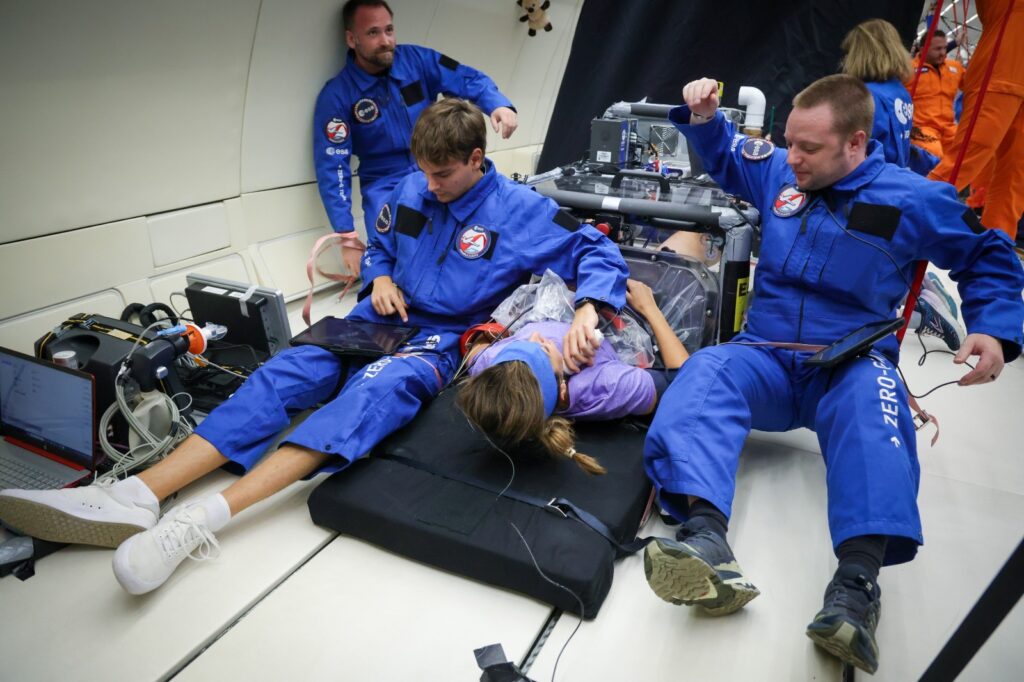
This experiment aims to better understand how the human body responds to graded Lower Body Negative Pressure (LBNP) under true microgravity conditions, provided by parabolic flight. LBNP is a promising countermeasure for the fluid shifts that occur in space, but most studies to date have been conducted on Earth using analogs such as supine or head-down tilt positions. While these approaches remove vertical hydrostatic gradients, they cannot fully replicate the absence of gravitational forces along the front-to-back human axis, which may influence venous return, tissue pressures, and overall cardiovascular regulation.

To address this limitation, our team will investigate cardiovascular, autonomic, and ocular responses to different levels of LBNP during short-duration microgravity phases in parabolic flight. By generating dose-response curves across multiple physiological systems, we aim to directly compare responses in true microgravity with those obtained under 1g analog conditions. The study will also assess sex-based differences in physiological adaptation, contributing to a more inclusive understanding of individual variability in countermeasure effectiveness and fluid regulation during spaceflight.

This project will deliver the most comprehensive and systematic dataset on LBNP responses ever collected in true microgravity. The results will inform the optimization of LBNP as a spaceflight health countermeasure, with direct applications for reducing risks such as Spaceflight-Associated Neuro-ocular Syndrome (SANS) and venous thromboembolism (VTE). Ultimately, the findings will help define the gravitational thresholds needed to maintain cardiovascular and ocular health duringlong-duration missions to the Moon and Mars.

Modeling Cardiovascular Physiology in Space

The cardiovascular (CV) system is one of the major physiological systems affected during spaceflight. Altered-gravity environments cause a change in the hydrostatic pressure distribution on the body, leading to a cephalad fluid shift where blood volume in the lower extremities reduces by up to 1L and increases in the trunk and head (also known as “puffy face/chicken leg” syndrome). This leads to hypovolemia, changes in hematocrit concentration, and aerobic deconditioning. It may also be a cause of spaceflight associated neuro-ocular syndrome (SANS).

We use a computational model of the CV system to reach beyond the limitations of existing data and study the effects of changing gravity levels. This model has been validated over a number of experimental studies and is continuously being extended to include the ability to model new conditions and physiological phenomena; including exercise, pulmonary function, long duration hemodynamic changes, and metabolic cost.

The CV model is being expanded to include cerebral autoregulation, which ensures a constant blood flow to the brain despite fluctuations in systemic blood pressure. Based on cerebral artery blood velocity findings from LBNP studies, we developed a cerebral autoregulation feedback mechanism that functions within the current CV model to analyze the dynamic blood flow behavior within the brain. This research effort creates a unique opportunity to explore cerebral perfusion in conditions where human experimentation is not feasible due to subject safety.

We are also integrating the ability to mimic trauma conditions and their associated CV effects for both astronauts and pilots. We are characterizing individual differences in a wide range of subject types – varying in body type, anthropometrics, sex, baseline CV characteristics, athletic ability, and hydration – to predict physiological responses to simulated acute blood loss in different gravity scenarios. A respiratory system model is also being developed to analyze the responses of hypoxic effects based on these individual differences.

Research by Subject

  • Altered Gravity Analog
  • Autonomy
  • Countermeasures
  • EVA
  • Exercise
  • Modeling
  • Performance
  • Physiology
  • Sensorimotor
  • VR
    • © 2018–2026 Bioastronautics and Human Performance Log in

      HRBB Rm 203

      College Station, Texas 77840

      Texas A&M Engineering Experiment Station Logo
      • Department of Aerospace Engineering
      • Twitter
      • State of Texas
      • Open Records
      • Risk, Fraud & Misconduct Hotline
      • Statewide Search
      • Site Links & Policies
      • Accommodations
      • Environmental Health, Safety & Security
      • Employment